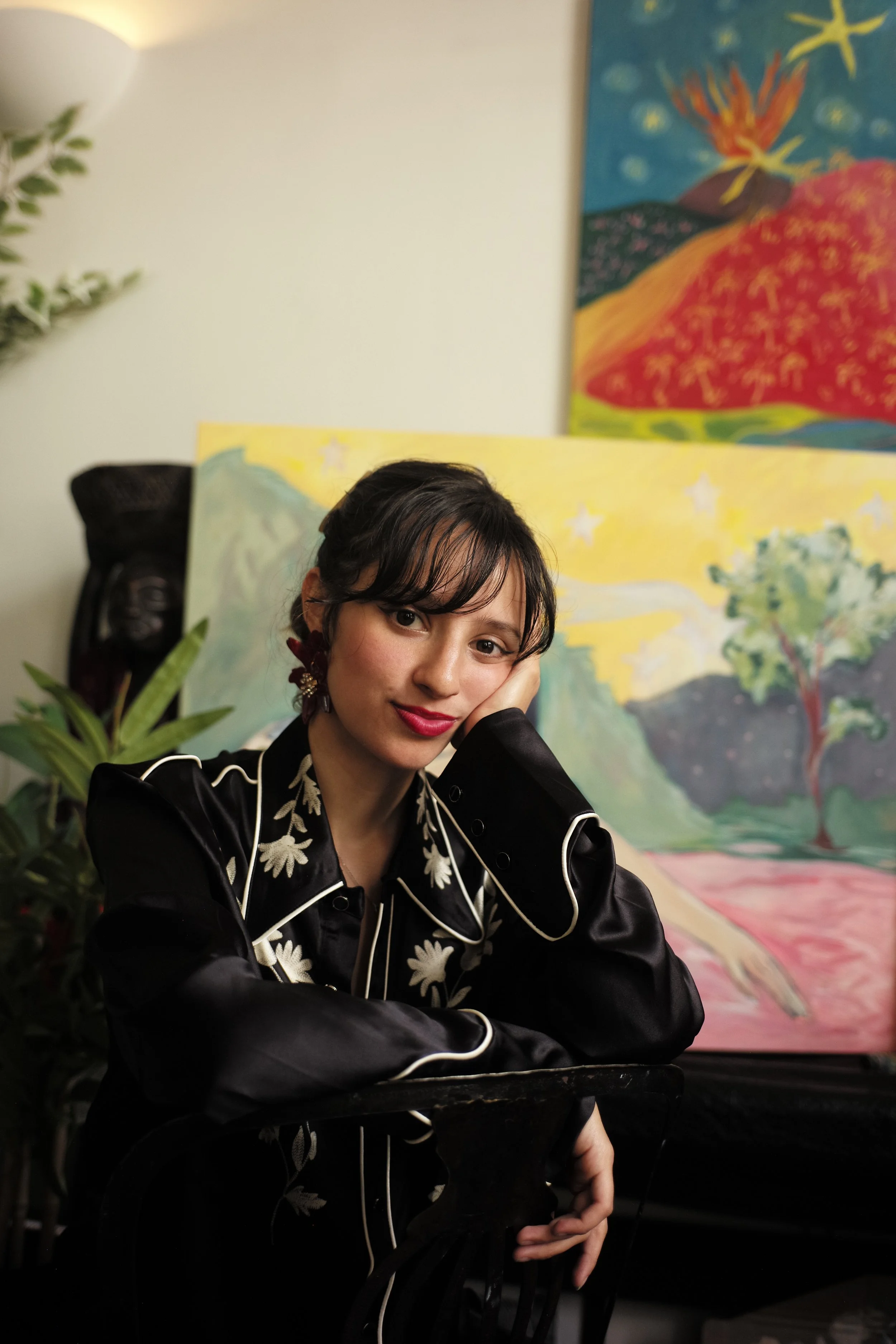
Born in Bogotá in 1999, Alejandra Álvarez is a Colombian artist and poet whose Andean roots deeply influence her way of seeing and inhabiting the world. She identifies herself as a daughter of Mother Nature, understanding creation as a sacred act through which the body, the heart, and the mind are reclaimed as territories, both personal and collective.
Álvarez’s artistic practice unfolds as a process of self-discovery and remembrance. Moving fluidly between painting, writing, and performance, her work explores themes of migration, identity, memory, and belonging. Symbolism plays a central role in her visual and poetic language: colors, gestures, and materials become carriers of spiritual beliefs, ancestral echoes, and intimate narratives. For the artist, color is not merely aesthetic but ritual, an act of filtering reality, transforming it, and returning it to the world charged with new meaning. Nature, personal history, and reflections on life, love, and death intertwine constantly in her work, forming a sensorial archive of wounds, tenderness, resistance, and transformation.
Through this intimate yet universal lens, Álvarez confronts her own fragilities with sensitivity while celebrating the resilience, beauty, and spiritual richness of her land and culture. Her art functions both as a personal testimony and as a mirror for those navigating the complexities of displacement, hybridity, and emotional survival.
Graduating Cum Laude from the Accademia di Belle Arti di Firenze in 2021, Álvarez has exhibited internationally. Her exhibitions include Re-Blossom (2021) and Incontri Creativi (2022) in Florence, Miradas Latinoamericanas (2023) in Paris, and her first solo exhibition, Ainsi Je Résiste (2023), also in Paris. Her performance practice has been presented at events such as Ridare l’Acqua al Popolo (2021) in Florence, Heart of the Underground (2023) in Paris, and La Nuit Européenne des Musées (2024) at Fondation Renaud in Lyon. In 2025, she participated in the first Auction Sale curated by Maison Bailly, further expanding her presence within the contemporary art scene. In 2024, she also broadened her international reach with her first solo exhibition in Asia, FLOWER POWER, following a residency with Ketemu Project in Bali. In 2026 she presented her latest solo exhibition Memoria de Sol at Espace Bouchor in Paris.
Álvarez is also the founder of FLOWERBED, a Paris-based art collective conceived as a fertile ground for encounter, creation, and collective imagination. FLOWERBED organizes artistic events, exhibitions, interdisciplinary gatherings, and hosts a weekly poetry circle, The Unicorn, at Mundolingua – The Museum of Languages. The collective also publishes the literary magazine EL JAGUAR, extending its commitment to the written word and to the dialogue between poetry, visual arts, and lived experience. Through FLOWERBED, Álvarez actively cultivates an international artistic community rooted in care, experimentation, and shared sensitivity. She currently lives and works in Paris, where she maintains her studio.
The most striking element about Alejandra Alvarez’s painting is the fundamental place of nature in the space of the canvas. Embracing, constant, superior, and magnified, it almost fully captures the attention. Sometimes treated with precision, it is more often represented in a moving harmony of flat tints and shades.
The artist tries to reconnect her soul with her body through the very essence of everything: Mother Earth. This is a personal quest, but more than anything, a will to find spirituality and greatness in a modern society that no longer prioritizes the living world. Nature plays a large part in the artist's heart as she grew up near it. Painting is a way of reconnecting with her origins and creating a sensitive, comforting, colorful, and bright world to escape the darkness of her mind.
Symbolism plays a greater part in her creative process as we see the emerging saturated oniric scenes of spiritual beings, fully transformed into a sensorial and serene experience of spirituality, highlighting the invisible connections between all things: the earth, the sky, the unknown, the body, and the soul.
Eléonore Scarvelis, Art researcher